

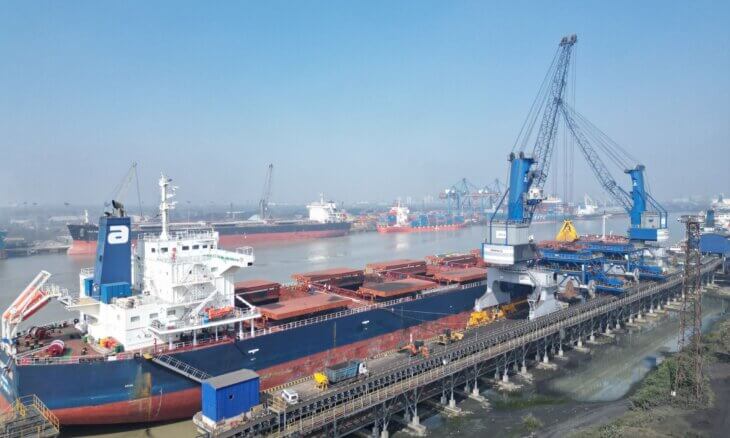
Prime Minister Narendra Modi has dedicated the Haldia Bulk Terminal (HBT) to the nation, marking a significant step in strengthening India’s port-led infrastructure along the eastern coast. Developed as a fully mechanised bulk cargo facility on the Hooghly River, the terminal has been designed to handle dry bulk commodities with an annual capacity of 4 million metric ton.
Located within the Haldia Dock Complex, the new terminal is expected to streamline cargo movement and enhance the efficiency of bulk handling operations in eastern India. The facility integrates modern automated systems and direct rail connectivity, enabling cargo discharged from ships to be transferred directly onto railway wagons, thereby reducing handling time and minimising cargo losses.
The terminal has been developed by Adani Ports and Special Economic Zone Ltd as part of broader efforts to modernise port infrastructure and improve logistics efficiency. According to Ashwani Gupta, Whole-time Director and CEO of the company, the project represents a major advancement in bulk cargo handling on the eastern seaboard. He noted that the facility introduces full mechanisation and eliminates traditional jetty dumping, resulting in cleaner operations while improving safety and sustainability standards.
A key feature of the terminal is the installation of a high-capacity Railway Wagon Loading System capable of handling 2,000 ton, supported by a 1.54 km dedicated railway line. This system enables direct ship-to-train cargo evacuation, reducing port dwell time and facilitating faster movement of raw materials to industrial centres across West Bengal, Odisha and Jharkhand.
The project also involved refurbishment of the existing jetty infrastructure and the installation of advanced conveyor systems to automate cargo transfer. The terminal’s stockyard operations are supported by two stacker-cum-reclaimers, while two mobile harbour cranes have been deployed to speed up vessel discharge operations.
With an installed capacity of 4 MMTPA, the terminal is designed primarily to handle dry bulk cargo such as coal and other industrial commodities. The berth features a draft of 8.5 m and a berth length of 193 m, with extreme mooring points extending to 337 m. Additionally, the facility includes a 2.10 km conveyor network to facilitate efficient cargo handling within the terminal.
The commissioning of the terminal aligns with the objectives of the Sagarmala Programme and the PM Gati Shakti National Master Plan, both aimed at strengthening multimodal logistics and reducing transportation costs across the country.
Industry observers note that the Haldia Bulk Terminal is expected to play a vital role in improving cargo evacuation efficiency from eastern ports while supporting the industrial supply chains of mineral-rich eastern states. By integrating port operations with rail logistics and automated cargo systems, the project underscores India’s ongoing push towards modern, technology-driven maritime infrastructure.