

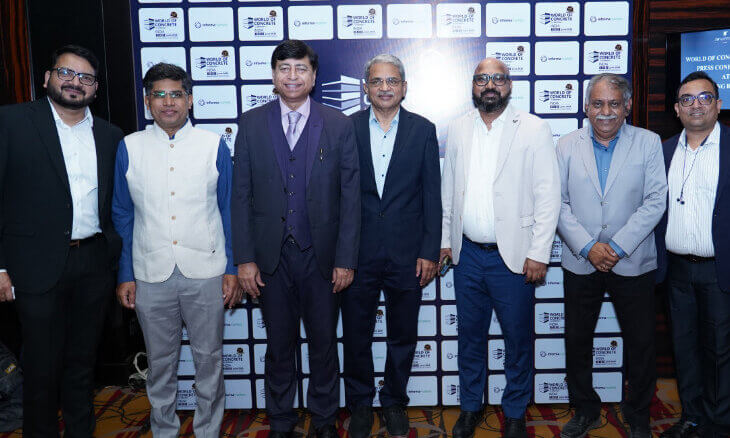
Industry leaders from the construction and concrete sectors gathered in Pune ahead of the upcoming World of Concrete (WoC) India 2026, underlining the growing importance of sustainability, mechanisation, digitalisation and advanced construction technologies in shaping India’s infrastructure future.
Organised by Informa Markets in India, the roundtable served as a precursor to the 12th edition of WoC India, scheduled to be held from June 3 to 5, 2026 at the Bombay Exhibition Centre, Mumbai. The event brought together representatives from the construction, concrete, architecture, industrial flooring, construction chemicals and market intelligence sectors to discuss evolving industry requirements and the road ahead for sustainable infrastructure development.
The upcoming edition of WoC India is expected to host more than 350 brands and attract over 18,000 industry professionals. Dedicated pavilions representing Europe, China, start-ups and precast technologies are also expected to strengthen the exhibition’s international participation.
Addressing the industry’s pressing concerns around technology adaptation, manpower and rising costs, Er Manoj Deshmukh, State Secretary, Builders Association of India (BAI), Pune Centre, said, “India’s contracting fraternity is at the receiving end, facing multiple challenges, from technology adoption, adaptation and rising costs to labour-related changes, skill gaps in technical manpower and payment delays. While we have evolved from contractors to constructors, the sector continues to depend heavily on human-intensive execution, and this makes skilling, statutory recognition of engineers and stronger industry-government dialogue critical. Despite these challenges, Indian constructors have consistently delivered complex projects with local manpower, meeting timelines and cost expectations. Platforms like World of Concrete India are important as they bring the industry together to discuss practical solutions, encourage technology adoption, and address key issues such as optimal use of resources, including water in construction.”
Highlighting the role of advanced repair materials and digital solutions in extending infrastructure life cycles, Jaswanth Sobhana, Director – Target Market & Product Management, Sika India, said, “Ageing buildings and infrastructure assets in India need new-age repair and rehabilitation materials that go beyond conventional solutions. Sika is already associated with strengthening projects for important structures in Delhi, as well as bridge assessment and repair initiatives for agencies such as NHAI and Indian Railways, helping extend asset life and reduce the need for demolition and reconstruction. Durability is now becoming a key design criterion, and if structures can be built for a life of 100 years or more, it is far more sustainable than rebuilding every 20–30 years. India’s construction chemical industry is around Rs 25,000 crore, but remains fragmented and largely unorganised. As a global leader, Sika continues to focus on innovation, sustainability and digitalisation, including AI-enabled tools for concrete mix design, sand grading and curing guidance. Platforms like World of Concrete India help bring these technologies closer to industry stakeholders and support better quality, performance-based construction practices.”
Discussing India’s expanding construction landscape, particularly across western India and emerging urban centres, Suyog Keluskar, Senior Director, 1Lattice, said, “India’s construction sector is witnessing strong growth, with cement production expected to be around 490 million ton in FY26, registering year-on-year growth of nearly 8–9 per cent. The government’s record capital expenditure allocation of Rs 12.2 lakh crore in the Union Budget 2026–27 is further driving development across highways, railways, logistics and regional infrastructure. Initiatives such as PMAY Urban 2.0, which aims to create 1 crore new homes, and the development of city economic regions are shifting growth beyond tier 1 cities. Western India, especially Mumbai and Pune, continues to be a key growth region, with Pune also seeing significant momentum in high-rise and urban construction. With 55–70 per cent blended cement usage, India is also moving towards more sustainable construction practices. As tier 2 and tier 3 cities become the next growth epicentres, concrete, construction chemicals and new-age technologies will play a critical role in building durable, sustainable and climate-resilient infrastructure.”
Speaking on mechanisation and workforce transformation, Ajay Singham, President, Industrial Flooring Association (IFA) & Managing Director, Avcon Technics, said, “India’s construction industry must move closer to the way manufacturing industries operate, with better planning, mechanised processes, trained operators and improved quality of life for workers. In industrial flooring, mechanisation has already reduced team sizes from 20-30 people to around 10, while increasing productivity from nearly 150 sq m to 1,500 sq m with the same team; globally, the benchmark is around 5,000 sq m With labour availability expected to become a bigger challenge, the future will be driven by mechanisation, precast solutions, materials, processes, equipment and know-how. Sectors such as data centres, currently at 1.5 to 1.6 GW with 277 facilities and expected to reach 6.5 GW by 2030, will require over 2.5 million sq m of flooring every year, making efficient timelines and technology adoption critical. World of Concrete India brings the right industry focus to concrete, resource efficiency and sustainability, especially as construction moves towards higher volumes, tighter timelines and greater dependence on technology.”
Appasaheb D. Bhosle, Past Secretary & EC Member Indian Concrete Institute, Pune centre, stressed the importance of modular construction and waste recycling, stating, “India’s construction sector is facing key challenges around skilled manpower, pollution and construction waste, making a strategic shift towards mechanisation and modular construction essential. While mechanisation is necessary, it also requires trained operators and stronger industry-institute integration to meet site requirements. Technologies such as precast modular systems can reduce on-site construction, manpower deployment and pollution, especially in dense redevelopment areas, while construction waste recycling must improve from the current 15 per cent in India towards higher global benchmarks of 60 to 90 per cent. With nearly 40 centres of the Indian Concrete Institute across India, platforms such as World of Concrete are important to spread awareness on technology, innovation, safety, economy, IoT, AI-driven machinery and modern construction practices.”
Emphasising awareness and accountability in sustainable construction, Prof AA Mahesh Bangad, Chairman, AESA EC / EC said, “Concrete is no longer just about contracting or material use, it now involves technology, machinery, innovation, education and practical application. As an association representing architects, engineers, builders and contractors for the past 55 years, we believe awareness is critical for better material adoption. The challenge is not only cost or contractor training, but also the need for clearer mandates, stronger policies, greater awareness and localised solutions. Sustainability is often overused as a term, and there is a need to combine traditional wisdom with new-age materials, stronger specifications and greater accountability. World of Concrete India can help build awareness, encourage moral responsibility and support the setting of much-needed norms for the construction industry.”
Commenting on the broader industry outlook, Yogesh Mudras, Managing Director, Informa Markets in India, stated, “India’s construction sector is scaling at an accelerated pace, with the real estate market projected to reach USD 1 trillion by 2030. Cities like Pune are emerging as key growth engines, supported by transformative infrastructure such as the Metro and Ring Road, along with a rapidly expanding industrial base. As new corridors open up and smart city initiatives gain momentum, the demand for resilient, high-performance, and sustainable construction materials is becoming increasingly critical. World of Concrete India 2026 aims to act as a medium for this shift by enabling knowledge exchange and accelerating the adoption of advanced solutions such as geopolymer concrete. By bringing together industry expertise, innovation, and global perspectives, the platform will help drive cost-efficiency, technical advancement, and long-term, responsible growth across India’s construction ecosystem.”
Adding to this, Rajneesh Khattar, Sr Group Director, Informa Markets in India, said, “With India taking significant strides towards building inclusive and sustainable infrastructure, this is a defining moment for the construction sector. World of Concrete India Expo 2026 goes beyond being just an exhibition, it is a platform where industry leadership, innovation, and actionable insights come together to shape the future of construction. Through focused industry discussions and knowledge-driven insights emerging from the platform, the show will enable stakeholders to better navigate challenges, adopt advanced technologies, and drive more efficient and sustainable construction practices. By bringing together global expertise and real-world application, we aim to accelerate the industry’s transition towards a more resilient and future-ready ecosystem.”
WoC India 2026 will feature product launches, live demonstrations, B2B and B2G meetings, as well as knowledge forums including the CEO Conclave, Open Tech Forum and Innovation Theatre. New additions such as the Investor Zone and Startup Pavilion are also expected to enhance engagement opportunities for industry stakeholders.