

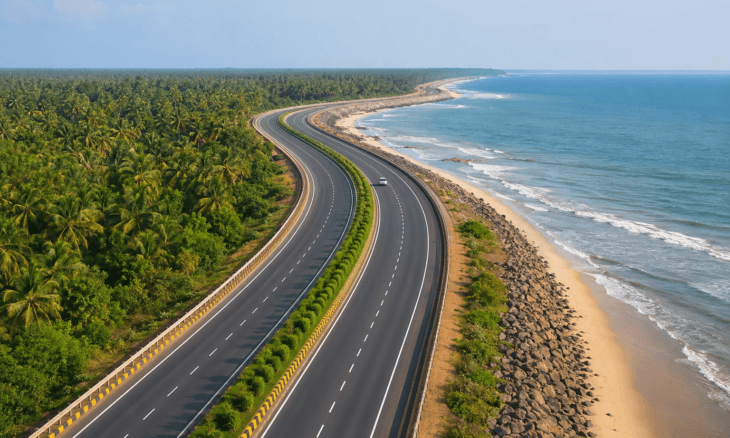
The Cabinet Committee on Economic Affairs (CCEA) has cleared the development of a new coastal highway connecting Rameshwar and Paradip in Odisha, paving the way for a major infrastructure upgrade along the state’s eastern coastline. The project, to be implemented under the Hybrid Annuity Model (HAM), will span a total length of 160.18 km and involve an investment of Rs 8,300.79 crore.
The proposed corridor will traverse the districts of Khurda, Puri, Kendrapada and Jagatsinghpur, creating an alternative high-speed route to support passenger and freight movement. The project has been divided into two packages, with the first section between Rameshwar and Konark being developed as a four-lane highway, while the stretch from Konark to Paradip will feature a two-lane carriageway with paved shoulders.
The new highway has been planned to address growing traffic challenges on existing routes. While NH-16 serves as a critical six-lane segment of the Golden Quadrilateral network, the connecting corridors towards Puri, Satapada and Konark experience significant congestion due to ribbon development and heavy local traffic. These constraints have affected travel efficiency and limited the corridor’s ability to support long-distance transportation.
Designed for speeds of up to 100 kmph, the highway is expected to significantly improve regional connectivity and strengthen links between key economic centres. The corridor is aligned with the PM GatiShakti framework and is expected to provide connectivity to nine economic nodes and five logistics nodes, reinforcing multimodal transportation networks and supporting supply chain efficiency.
Apart from enhancing mobility, the project is expected to contribute to Odisha’s socio-economic development by improving access to industrial, commercial and tourism destinations. Once operational, the corridor is projected to reduce travel time between Rameshwar and Paradip by approximately two and a half hours, while also lowering vehicle operating costs, fuel consumption and carbon emissions.
The project is anticipated to play an important role in strengthening coastal infrastructure, improving freight movement efficiency and supporting the country’s broader logistics and connectivity objectives.