
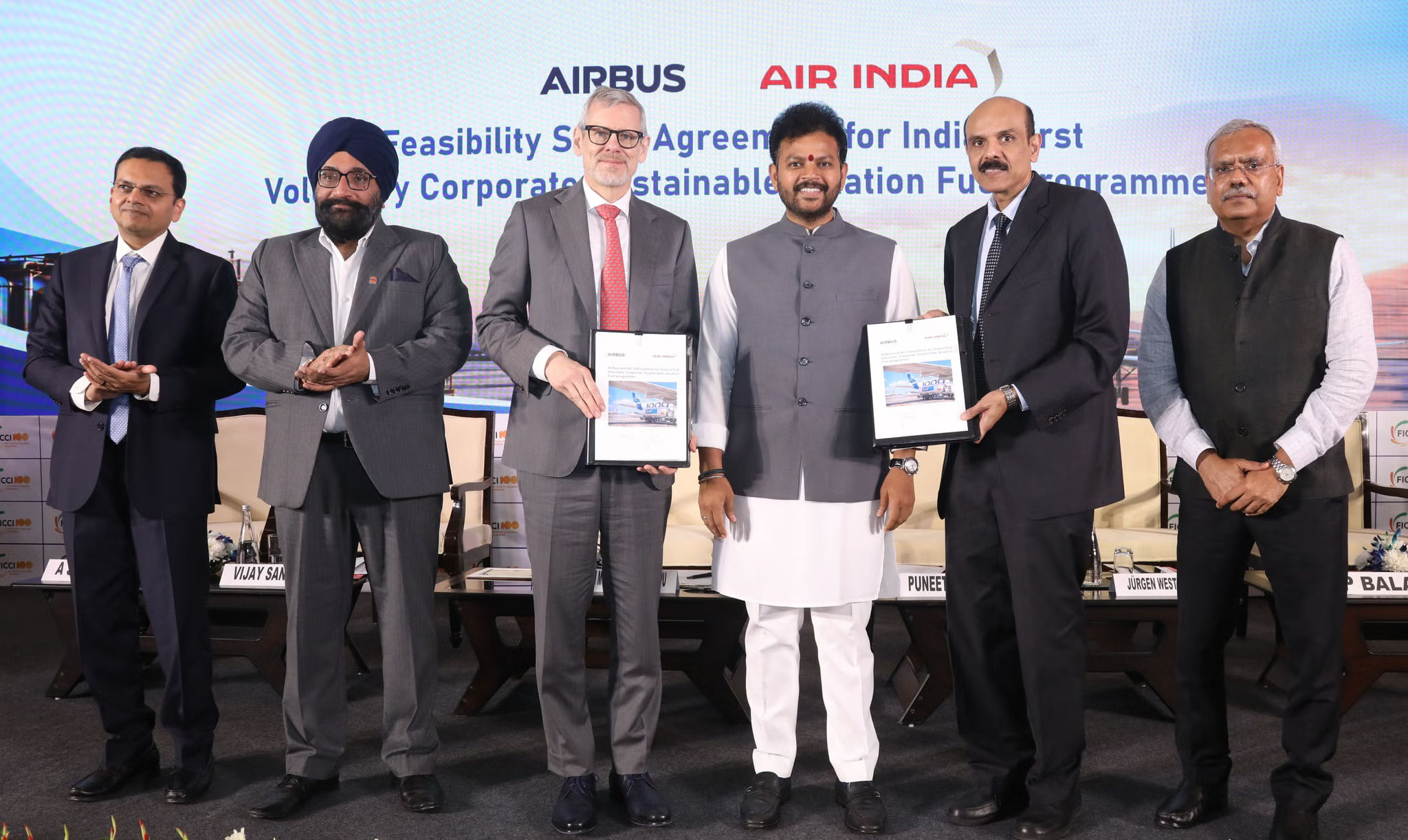
Air India and Airbus have signed a Feasibility Study Agreement to develop a framework for India’s first voluntary corporate Sustainable Aviation Fuel (SAF) programme. The initiative aims to enable businesses across sectors to support SAF adoption and reduce lifecycle emissions associated with air travel.
Under the proposed framework, Air India would procure and use SAF on selected routes and offer eligible corporate customers the associated Scope 3 SAF certificates (SAFc). These certificates would allow participating businesses to account for verified emissions reductions and track progress towards their sustainability goals.
Tewolde Gebremariam, CEO and Managing Director, Air India, said: “Achieving aviation’s decarbonisation goals will require collective action across the ecosystem. Through this collaboration with Airbus, we are exploring a credible mechanism that enables corporates to support SAF adoption and reduce the emissions associated with business travel. Expanding demand for SAF is essential to scaling production and building a sustainable aviation ecosystem in India, and we are pleased to help lead that effort.”
Jürgen Westermeier, President and Managing Director, Airbus India and South Asia, said: “Sustainable Aviation Fuel holds the most realistic potential to decarbonise aviation. Airbus is privileged to act as a catalyst to galvanise the SAF ecosystem by collaborating with regulators, airlines, airports, fuel producers and research bodies globally. “The collaboration with Air India is a crucial stepping stone to accelerate SAF adoption in the region. Decarbonising aviation demands collective, industry-wide action, and we welcome other corporates to join the programme.”
P Balaji, Group Head – GRC and Corporate Affairs, Air India, said: “Building a viable SAF ecosystem requires demand, collaboration and industry participation. Through this initiative, we aim to create a framework that enables corporates to play a meaningful role in accelerating SAF adoption in India.”
The feasibility study will assess how emissions savings can be calculated by comparing the lifecycle carbon footprint of SAF with conventional jet fuel under globally recognised standards. It will also examine ways to scale the programme and encourage participation from businesses across different sectors.
The initiative complements the companies’ wider sustainability efforts, including fleet modernisation, operational efficiency and greater use of cleaner fuels. Air India has 600 new aircraft on order, including 350 from Airbus, alongside measures such as optimised flight planning, single-engine taxiing, electric-vehicle towing and reduced use of single-use plastics.
