

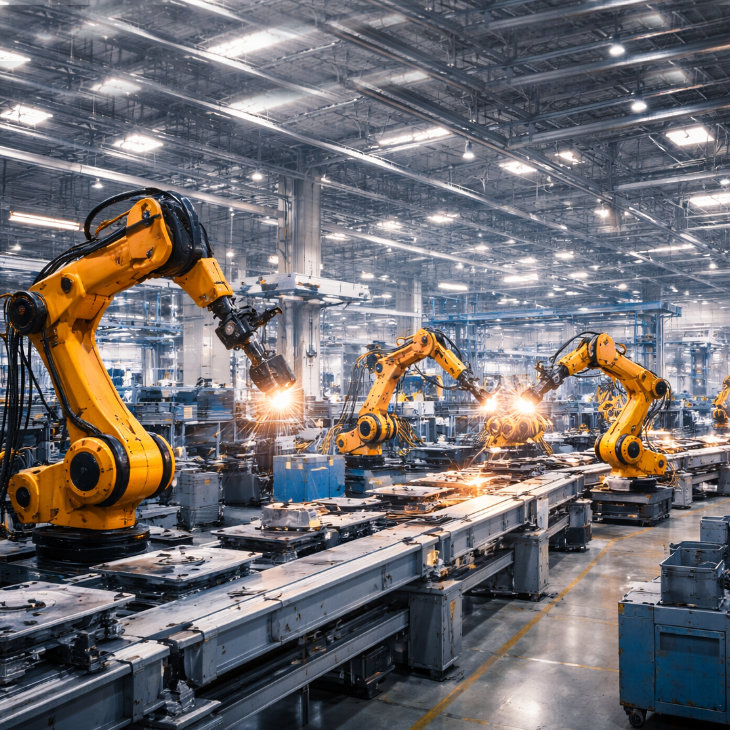
The Union Budget 2026–27 has outlined a clear manufacturing-led growth roadmap, with a focus on competitiveness, scale and technology upgradation as India positions itself for the next phase of industrial expansion.
A key announcement is the revival of 200 legacy industrial clusters, aimed at improving cost efficiency and productivity through infrastructure modernisation and technology upgrades. The Budget also proposed expansion across strategic manufacturing sectors, including electronics, chemicals, rare earths and capital goods, to strengthen domestic value chains and reduce import dependence.
Support for micro, small and medium enterprises has been significantly reinforced through the introduction of a Rs 10,000 crore SME Growth Fund, along with an additional Rs 2,000 crore infusion into the Self-Reliant India Fund. Liquidity access for MSMEs will be enhanced through mandatory adoption of TReDS, credit guarantee support via CGTMSE, and deeper integration with the GeM platform, improving cash flows and financing access across the manufacturing ecosystem.
Commenting on the broader manufacturing outlook, Sudhanshu Vats, Managing Director, Pidilite Industries Ltd, said, “The Union Budget 2026–27 reinforces strong confidence in India’s growth trajectory, anchored in manufacturing, infrastructure and consumption.” He added that “the continued focus on domestic manufacturing across chemicals, electronics and capital goods strengthens supply-chain resilience and supports India’s ambition to be a globally competitive production hub.”
Vats further noted that “with public capex at Rs 12.2 lakh crore, demand across housing, construction and infrastructure-linked industries will remain robust, directly benefiting the building materials and adhesives ecosystem,” while highlighting that “the emphasis on digital infrastructure, Automation & AI-led Customs reforms and trade facilitation will enhance ease of doing business and global integration.”
Highlighting the regional development aspect, Puneet Vidyarthi, Head of Brand Marketing, CASE Construction India & APAC and President, Rural Marketing Association of India, said, “The Budget’s continued focus on infrastructure-led growth beyond metros is a positive signal.” He added that “greater emphasis on connectivity and localised development can help accelerate economic activity across semi-urban and rural markets.”
Vidyarthi further observed that “as development expands closer to these regions, building skills at the grassroots level becomes equally important to support efficient execution and long-term impact,” noting that “together, these measures can contribute to more balanced growth while strengthening local economies and market potential.”
Overall, the combined thrust on cluster revitalisation, MSME financing, strategic manufacturing sectors and ease of doing business reforms is expected to deepen India’s industrial base, support employment generation and enhance export competitiveness, in line with the country’s long-term Viksit Bharat vision.