

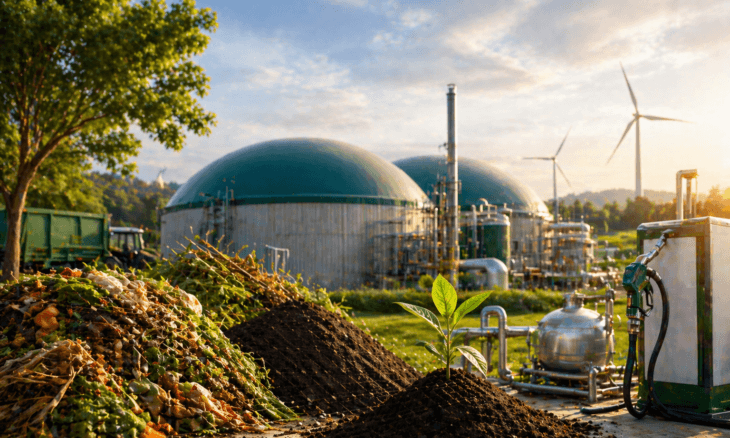
Maharashtra has unveiled an ambitious policy framework to scale up compressed biogas (CBG) production, earmarking Rs 500 crore for 2026–27 to convert municipal and agricultural waste streams into clean fuel and organic fertiliser. The move positions waste as a resource, targeting reduced landfill dependence while strengthening the state’s alternative energy mix.
The policy prioritises the utilisation of segregated biodegradable waste from urban centres, placing urban local bodies at the forefront of execution. Alongside city waste, crop residue and cattle waste will serve as critical feedstock, with cluster-based models planned for regions where supply volumes are limited.
Large-scale facilities are central to the strategy, with biogas plants of at least 200 ton per day to be developed under public-private partnership structures. To improve project bankability, the state will introduce assured payment mechanisms, while also offering land on lease and expedited clearances through a single-window system. A dedicated digital platform will further streamline linkages between waste generators and plant developers.
Beyond energy generation, the initiative aims to address multiple environmental and economic challenges. By reducing dumping and associated pollution, improving resource recovery, and creating new income channels for farmers, the policy lays the groundwork for a circular waste economy while advancing Maharashtra’s clean energy transition.