

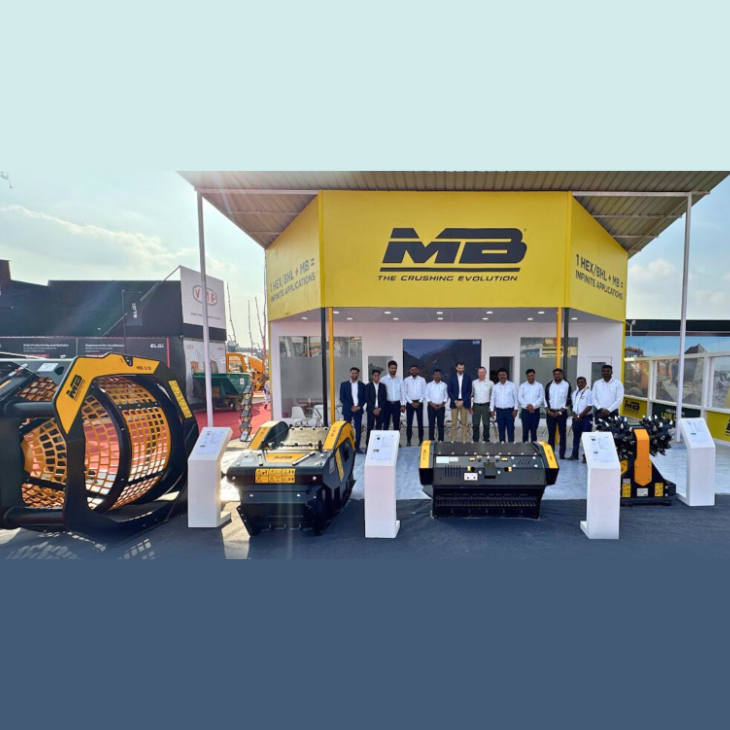
MB Crusher India concluded a significant and impactful participation at EXCON 2025, underlining its growing role as a technology-driven solution provider for on-site material processing and sustainable construction practices in India. The company’s presence at the exhibition reflected a clear shift in market expectations, with contractors, recyclers, rental companies, and infrastructure developers increasingly prioritising efficiency, adaptability, and lifecycle value over conventional equipment purchasing metrics.
According to Piero Guizzetti, CEO, MB Crusher India, conversations during the exhibition highlighted a fundamental change in how Indian customers assess equipment and attachments. “The focus has moved beyond upfront price. Contractors today are evaluating productivity, machine utilisation, lifecycle value, and the ability to manage materials efficiently on site. EXCON 2025 confirmed that this shift is real and accelerating.”
Strong Interest in On-Site Processing Solutions
At the exhibition, MB Crusher India showcased a focused portfolio of attachments designed to address real-world job-site challenges across demolition, road construction, urban redevelopment, and recycling applications.
The BF90.3 crusher bucket emerged as a major attraction, with visitors engaging in in-depth discussions on on-site crushing, minimising material transportation, and reusing aggregates directly at project locations. The solution resonated strongly with contractors seeking to reduce logistics costs while retaining control over material quality and project timelines.
In parallel, screening buckets and compact crusher buckets such as the MB-L160 and BF60.1, along with the MB-R800 drum cutter, drew interest from customers operating in confined and urban environments. These attachments demonstrated how existing machines can be transformed into multi-functional tools without expanding fleet size or adding operational complexity.
Attachments Gaining Strategic Importance
A key takeaway from EXCON 2025 was the increasing recognition of attachments as core productivity enablers rather than auxiliary tools. Contractors are now integrating attachments into project planning to allow a single carrier machine to perform multiple functions across different phases of construction.
“Attachments are becoming central to project planning,” said Guizzetti. “They allow contractors to adapt quickly, reduce idle time, and improve overall efficiency without additional capital investment in new machines.”
This approach aligns closely with the expansion of rental and shared-fleet models in India, where versatility, durability, and consistent performance across operators are critical. MB Crusher’s hydraulically operated attachments and robust design are well suited to such operating environments.
Focus on Localised Support and Applications
Beyond product display, MB Crusher India continued to emphasise its localisation strategy, centred on application engineering, operator training, and on-site demonstrations adapted to Indian operating conditions. The company works closely with customers to address challenges related to local rock types, demolition waste composition, and seasonal constraints, ensuring that equipment delivers reliable performance in real project scenarios.
Market Outlook
Looking ahead, MB Crusher India anticipates steady growth through 2026–27, driven by infrastructure expansion, urban redevelopment, and increasing emphasis on sustainability and construction waste management. While demand for new equipment remains relevant, the market is clearly shifting toward solutions that enhance efficiency and lower operating costs.
On-site recycling and material processing are expected to gain broader acceptance as contractors and project owners seek practical, compliant, and cost-effective ways to manage construction and demolition waste.
“The market is moving toward smarter use of resources,” Guizzetti added. “Solutions that combine productivity with sustainability will play a larger role in how projects are executed. MB Crusher is committed to supporting that transition in India.”