

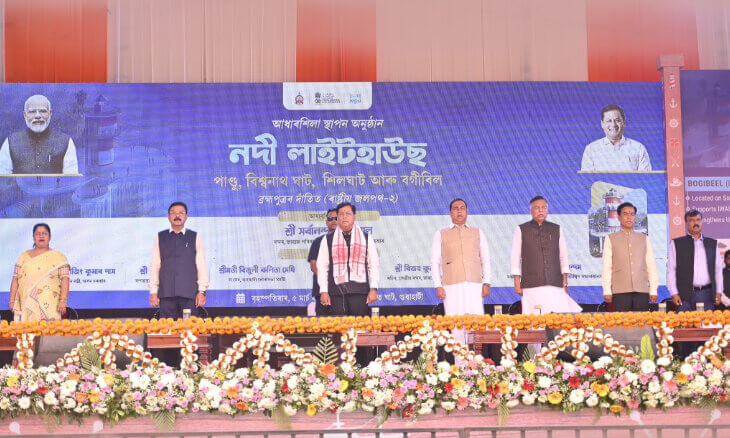
India has taken a significant step towards strengthening inland waterway infrastructure with the launch of river lighthouse projects along the Brahmaputra River. The initiative marks the first instance of lighthouse facilities being established on an inland waterway in the country, aimed at improving navigational safety and supporting the expanding role of river transport.
The foundation stones for four river lighthouses were laid by Sarbananda Sonowal along the Brahmaputra, part of National Waterway‑2, a key route for cargo and passenger movement in Northeast India. The ceremony took place at Lachit Ghat and was organised by the Directorate General of Lighthouses and Lightships and the Inland Waterways Authority of India under the Ministry of Ports, Shipping and Waterways.
The four lighthouse sites have been identified at Bogibeel in Dibrugarh district, Pandu in Kamrup (Metro) district, Silghat in Nagaon district and Biswanath Ghat in Biswanath district. While three of the locations are situated along the south bank of the river, the Biswanath Ghat site will serve the north bank. The total investment for the project is estimated at approximately Rs 84 crore.
Each lighthouse will rise to a height of about 20 m and will be equipped with modern navigational lighting systems capable of offering a geographical range of 14 nautical miles and a luminous range of 8–10 nautical miles. The structures will operate entirely on solar energy, aligning with sustainable infrastructure goals. In addition to their primary navigational function, the sites will also feature tourism-oriented facilities such as museums, amphitheatres, cafeterias, children’s play areas, souvenir shops and landscaped public areas.
The project is being implemented in response to the growing utilisation of the Brahmaputra waterway for freight and passenger movement. Cargo traffic on National Waterway-2 recorded a notable rise of around 53 per cent during the financial year 2024–25, highlighting the increasing importance of the corridor in regional logistics. The waterway plays a key role in transporting commodities such as tea, coal and fertilisers while also supporting tourism and passenger services.
The installation of lighthouse infrastructure and modern navigation aids is expected to enable safer and more reliable vessel movement, including round-the-clock navigation along the river. The facilities will also incorporate weather monitoring sensors and navigation support systems to enhance operational safety and efficiency.
The river lighthouse initiative emerged from efforts to explore the feasibility of such infrastructure in the Northeast. A memorandum of understanding between the Inland Waterways Authority of India and the Directorate General of Lighthouses and Lightships was signed in April 2025 covering the four locations. The project sites were subsequently transferred under Right of Use agreements in June 2025, following technical approvals. Construction of the lighthouses is expected to be completed within 24 months after the award of contracts.
National Waterway-2 stretches from Dhubri to Sadiya across a navigable length of about 891 kilometres along the Brahmaputra, making it the longest navigable inland waterway corridor in the country. The proposed river lighthouses represent an important step towards equipping India’s inland waterways with modern navigational infrastructure similar to that used along coastal shipping routes.