

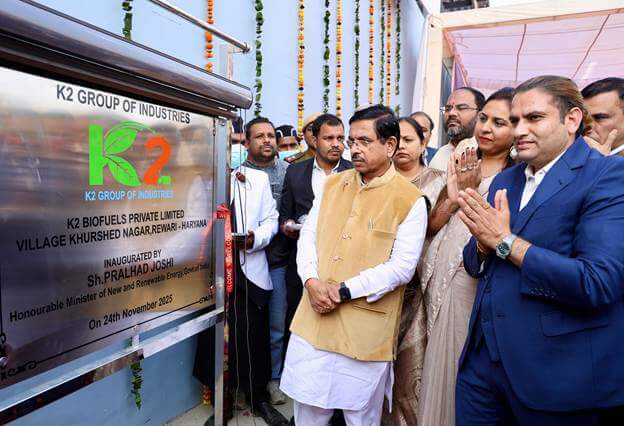
Union Minister for New & Renewable Energy, Pralhad Joshi, inaugurated a state-of-the-art 240 TPD biomass pellet manufacturing facility in Rewari, marking a significant step in Haryana’s clean energy expansion. The facility is designed to process agricultural residues—including paddy straw, mustard straw and cotton stalks—into biomass pellets for co-firing in thermal power plants.
The Minister said the project reinforces Haryana’s emergence as a key contributor to India’s renewable energy transition. He highlighted the Government of India’s recently notified policy mandating biomass pellet or torrefied MSW charcoal co-firing in all coal-based thermal power stations. As per this policy, plants nationwide must co-fire 5 per cent biomass or MSW charcoal by weight, while units in the Delhi-NCR region will adopt a 7 per cent blend. For NCR installations, at least half of the required biomass will be sourced from locally available paddy residue, helping reduce stubble burning and supporting sustainable supply chains.
Emphasising the dual benefits of pollution mitigation and rural income generation, the Minister said the Rewari biomass pellet unit will enhance clean fuel availability while creating fresh livelihood avenues for farmers. He described the initiative as an important stride toward the nation’s goal of a secure and sustainable energy future.
Shri Joshi noted that robust source segregation and regulatory systems are being strengthened to improve the availability of MSW-derived charcoal, given existing challenges with wet and unsegregated waste.
Underlining the Centre’s sustained commitment to Haryana’s development, the Minister said the State has benefitted from a decade of accelerated power sector growth, with India nearly doubling its electricity generation capacity and emerging as a power-exporting nation. Haryana currently has over 12 GW of capacity and is poised to reach 24 GW in the coming years.
Providing an overview of Haryana’s renewable achievements, the Minister stated that the State has installed more than 2.8 GW of clean energy capacity, including 2.4 GW of solar power. More than two lakh households have applied under the PM Surya Ghar Muft Bijli Yojana, with over 45,000 rooftop solar installations already operational. Under PM-KUSUM, the State has deployed 18.61 MW under Component A and installed over 1.74 lakh solar pumps, enabling farmers to irrigate using solar energy.
The Minister also underlined Haryana’s progress in green hydrogen, with pioneering projects underway in Hisar, Panipat and Jhajjar. The State’s biomass potential exceeds 1,350 MW, complemented by a network of 26 waste-to-energy units totalling nearly 49 MW.
Reaffirming the Union Government’s support for Haryana’s clean energy aspirations, Shri Joshi said the people of the State have consistently contributed to national progress and are now leading India’s transition toward a greener energy future.