

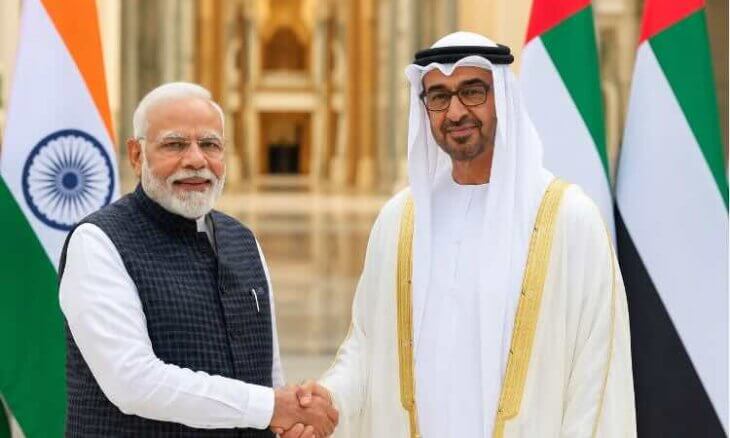
India and the United Arab Emirates (UAE) have significantly deepened their strategic partnership, signing a series of agreements spanning energy, defence, maritime infrastructure, artificial intelligence, and advanced technologies during Prime Minister Narendra Modi’s visit to Abu Dhabi. Marking a major economic boost, the UAE also announced investments worth $5 billion in India.
According to India’s Ministry of External Affairs (MEA), leaders from both countries reviewed the full spectrum of bilateral relations and reaffirmed their commitment to expanding cooperation across key sectors including trade, investment, defence, security, fintech, infrastructure, education, and culture. Both sides also welcomed the continued success of the India-UAE Comprehensive Economic Partnership Agreement (CEPA), which has played a key role in strengthening bilateral trade and economic engagement.
A major highlight of the visit was Abu Dhabi’s commitment to invest $5 billion in India through multiple channels. The investment package includes $3 billion by Emirates New Development Bank (ENDB) in RBL Bank, $1 billion by Abu Dhabi Investment Authority (ADIA) in partnership with the National Infrastructure & Investment Fund (NIIF) for infrastructure projects, and an additional $1 billion investment by International Holding Company in Sammaan Capital.
In the energy sector, Indian Strategic Petroleum Reserves Limited and Abu Dhabi National Oil Company (ADNOC) signed a strategic collaboration agreement to strengthen the UAE’s role in India’s strategic petroleum reserves and explore the development of strategic gas reserves. Indian Oil Corporation (IOCL) and ADNOC also concluded a long-term agreement for LPG supply, reinforcing energy security cooperation between the two nations.
Defence cooperation also received a significant boost with the signing of a Framework for Strategic Defence Partnership. The agreement seeks to deepen industrial collaboration and enhance cooperation in advanced technologies, maritime security, cyber defence, training, secure communication systems, and intelligence sharing.
Maritime infrastructure emerged as another key area of focus. An MoU between Cochin Shipyard Ltd and Drydocks World, Dubai was signed to establish a ship repair cluster at Vadinar under India’s Maritime Development Fund Scheme. Additionally, a tripartite agreement involving Cochin Shipyard, Drydocks World, and the Centre of Excellence in Maritime & Shipbuilding (CEMS) will support skill development in shipbuilding and repair.
Further advancing technology collaboration, India’s Centre for Development of Advanced Computing (C-DAC) partnered with UAE-based G42 to establish an 8 Exaflop Super Compute Cluster to support India’s AI Mission and strengthen advanced computing infrastructure.
The two countries also welcomed the operationalisation of the Virtual Trade Corridor through the MAITRI digital platform, aimed at streamlining customs and port connectivity, reducing cargo transit time, and lowering logistics costs.
Prime Minister Modi thanked UAE President Sheikh Mohamed bin Zayed Al Nahyan for the warm hospitality during the visit and extended an invitation for him to visit India, underscoring the growing momentum in India-UAE relations.