

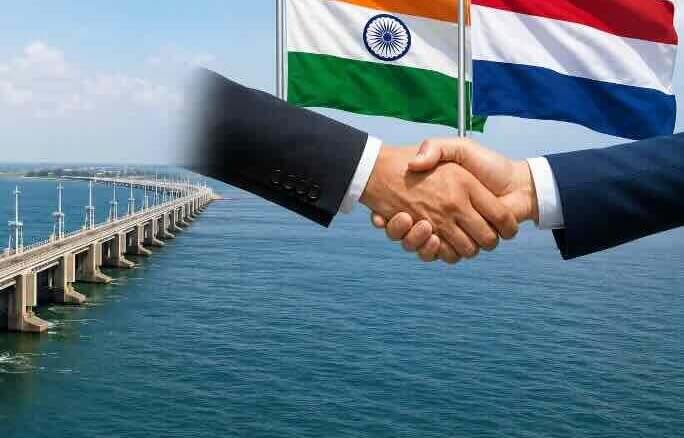
India and the Netherlands have taken a major step towards advancing Gujarat’s ambitious Kalpasar Project, with both nations signing a Letter of Intent (LoI) to strengthen technical cooperation on the large-scale freshwater reservoir initiative. The agreement was formalised between India’s Ministry of Jal Shakti and the Netherlands’ Ministry of Infrastructure and Water Management during Prime Minister Narendra Modi’s diplomatic visit to the European nation.
The development gained momentum after Prime Minister Modi, accompanied by Dutch Prime Minister Rob Jetten, visited the Netherlands’ iconic Afsluitdijk water management system — a 32-km barrier dam widely recognised for its advanced marine engineering and flood management capabilities. Observing similarities between the Dutch structure and Gujarat’s proposed Kalpasar Project, PM Modi highlighted the relevance of Dutch expertise in supporting India’s long-pending reservoir initiative.
The collaboration is expected to expedite implementation of the Kalpasar Project by enabling technical knowledge transfer from the Netherlands, which brings over nine decades of experience in marine dam construction, water management, and flood control. The partnership further strengthens the India–Netherlands Strategic Partnership on Water established in March 2022.
Originally envisioned during Narendra Modi’s tenure as Gujarat Chief Minister, the Kalpasar Project proposes the construction of a massive dam across the Gulf of Khambhat to impound waters from seven rivers currently flowing into the Arabian Sea. The reservoir is aimed at enhancing long-term water security for the state, reducing dependence on the Sardar Sarovar Dam, and ensuring reliable water supply for drinking and irrigation, particularly across drought-prone regions.
Despite its transformative potential, the project has encountered significant delays owing to complex marine engineering challenges. However, recent diplomatic engagements have revived momentum. In March, Gujarat Chief Minister Bhupendra Patel met Netherlands Ambassador Marisa Gerards in Gandhinagar to discuss establishing an Indo-Dutch expert group to address technical hurdles. Adding to the project’s credibility, global maritime engineering consultancy Royal Haskoning has already contributed to developing the dam’s closure methodology in the project’s detailed report.
Upon completion, the multi-purpose Kalpasar Project is expected to irrigate nearly 10 lakh hectares across 42 talukas in nine districts of Saurashtra. The infrastructure will also substantially improve regional connectivity by reducing travel distance between South Gujarat and Saurashtra from 240 km to 60 km. In addition, the project is planned to generate 1,500 MW of wind power and 1,000 MW of solar energy, while creating opportunities for fisheries development and tourism growth.
The India–Netherlands collaboration is expected to play a pivotal role in transforming the long-envisioned Kalpasar Project from concept to execution, potentially reshaping Gujarat’s water, transport, and energy landscape.