

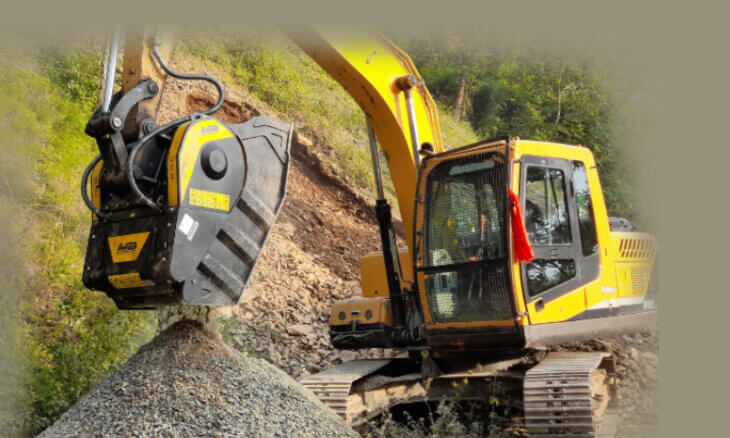
MB Crusher India Pvt Ltd has released a compilation of three verified field case studies documenting the on-site performance of its crusher bucket and screening bucket attachments across varied and demanding Indian site conditions. Spanning road construction in a northeastern hill state, a remote mini hydropower project in the far eastern region, and a coal handling facility in coastal Andhra Pradesh, the deployments collectively underscore a critical shift in material processing practices.
At the core of these case studies lies a persistent operational bottleneck in India’s construction, mining, and material-handling ecosystem—the inability of fixed crushing plants to adapt to dynamic work fronts, operate without grid power, and function efficiently with limited manpower. MB Crusher’s excavator-mounted attachments present a decentralised alternative, bringing crushing capabilities directly to the point of material extraction and handling.
Case 1: Road Construction, Northeastern Hill State
A civil contractor executing road construction across a 20-plus km mountainous stretch transitioned from a 120 TPH stationary jaw crusher to a fleet of MB Crusher attachments—BF60.1 and BF70.2 crusher buckets, along with an MB-S14 screening bucket—mounted on existing excavators.
The stationary setup demanded extensive logistical planning for relocation, a dedicated power source, and a separate labour crew. In rugged terrain with locally sourced stone, operational inefficiencies such as jaw choking and frequent stoppages led to project delays. Labour shortages following the pandemic further strained operations.
With the deployment of MB attachments, the crushing process was consolidated into the excavators already present on site, each requiring only a single operator. The mobile setup enabled crushing to occur directly at the extraction point, producing 50–60 mm material from river stones and eliminating secondary haulage. This approach supported the successful completion of over 20 km of road work.
Case 2: 2 MW Mini Hydropower Project, Far Eastern Region
At a 2 MW mini hydropower project in the far eastern hill states, a site engineer deployed the BF90.3 crusher bucket on an existing excavator to produce 20 mm and 40 mm aggregates from locally blasted rock.
The project faced significant constraints, including the absence of grid power, lack of access roads for heavy equipment transport, and no nearby supply of processed aggregates. While a diesel-powered crusher was considered, it was ruled out due to high fuel consumption and maintenance challenges in a region with no service infrastructure.
Operating entirely through the excavator’s hydraulic system, the BF90.3 required no external power source and did not increase fuel consumption beyond standard excavation operations. The same operator handled both excavation and crushing, ensuring seamless workflow integration. The site maintained uninterrupted aggregate production throughout the project lifecycle without critical downtime.
Case 3: Coal Trading & Handling Facility, Coastal Andhra Pradesh
A coal trading yard in coastal Andhra Pradesh adopted the BF90.3 crusher bucket to address inefficiencies in its material handling cycle.
Previously, oversized coal lumps required a secondary handling process—transporting material from the intake zone to a fixed crusher before dispatch. This added to machine hours, fuel usage, and manpower requirements, while the static crusher struggled to keep pace with the yard’s multi-zone operations.
By mounting the BF90.3 on an existing excavator, the operator began crushing oversized coal inline during unloading and stacking. This eliminated the need for a separate handling cycle, enabling real-time processing and removing the bottleneck associated with fixed crushing infrastructure.
“These three sites represent conditions that most fixed crushing plants simply cannot serve — no power, no access, no stable location. The results confirm that attachment-based crushing is not a compromise for Indian contractors. It is, in many cases, the only method that works.”
— MB Crusher India Pvt Ltd, Technical & Sales Team
Why This Matters for the Indian Market
India’s infrastructure expansion is increasingly moving into geographies and project types where traditional fixed crushing setups are impractical. From mountainous highway corridors and rural road networks to remote hydropower installations and port-based material handling hubs, contractors are consistently encountering constraints related to power availability, space limitations, mobility, and workforce availability.
Excavator-mounted crusher buckets offer a unified solution to these challenges. Powered by the carrier machine’s hydraulic system, they eliminate the need for separate energy sources, require no additional footprint, and can be relocated instantly as project demands shift. Importantly, they operate using the same manpower already deployed for excavation tasks.
Across the documented case studies, these advantages translated into measurable operational gains—reduced logistics costs, elimination of auxiliary equipment, lower manpower dependency, and payback periods of under 12 months.
For contractors engaged in stretch-based road projects, EPC firms operating in remote terrains, and material handlers dealing with variable feed conditions, the findings reinforce a growing industry transition: from fixed, centralised crushing to flexible, on-site processing solutions tailored to India’s evolving infrastructure landscape.