

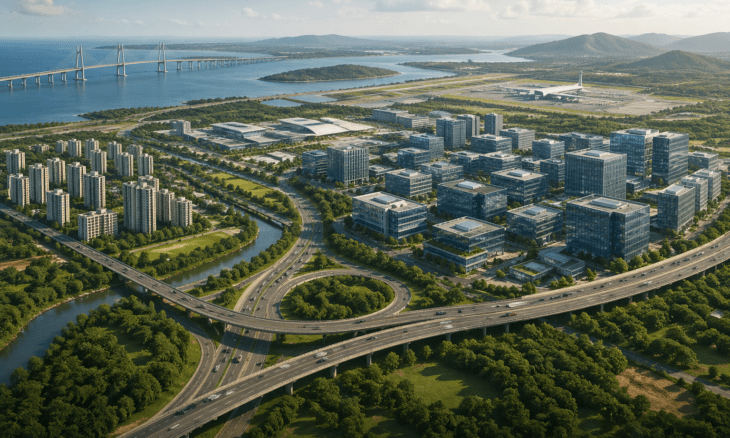
Mumbai Metropolitan Region Development Authority has taken a significant step forward in advancing the Mumbai 3.0 vision by aggregating 216 acre of land in the Pen growth corridor of Raigad district. The development marks a transition from planning to early-stage execution for one of the region’s most closely watched urban expansion initiatives.
The project is being positioned as a long-term strategy to decongest Mumbai while establishing new economic centres across the metropolitan region. The Raigad corridor is among the first nodes identified under this broader expansion framework.
A notable aspect of the initiative is its approach to land acquisition. Moving away from conventional models, the authority has implemented a participatory mechanism that allows landowners to choose between monetary compensation, development rights such as Floor Space Index (FSI) or Transferable Development Rights (TDR), and land pooling options. Under the pooling structure, stakeholders are entitled to a share of the developed land, enabling them to participate in the value creation process. This approach is aimed at minimising disputes and accelerating land consolidation.
Strategically located, the Pen corridor is expected to benefit from its proximity to major infrastructure projects including the Mumbai Trans Harbour Link, the upcoming Navi Mumbai International Airport, and the proposed Virar–Alibaug Multi-Modal Corridor. These linkages are anticipated to enhance regional connectivity and unlock new development potential across the Mumbai Metropolitan Region.
The broader vision for Mumbai 3.0 extends beyond spatial expansion. Plans indicate the creation of a self-sustained urban ecosystem comprising technology and financial districts, Global Capability Centres, data centres, and microelectronics hubs. The blueprint also integrates IT and IT-enabled services zones, along with essential social infrastructure such as healthcare and education facilities. Logistics and warehousing infrastructure are expected to play a key role, given the corridor’s positioning within emerging supply chain networks.
From an economic standpoint, the project is projected to generate substantial employment opportunities, with estimates indicating the creation of over two lakh direct jobs alongside significant indirect employment. The scale and diversity of planned developments are also likely to attract both domestic and international investments.
The real estate sector is expected to respond strongly to this development. The Pen corridor, historically considered peripheral, is likely to witness increased interest across residential, commercial, and industrial segments. Improved connectivity and proximity to major infrastructure projects are expected to drive land value appreciation in the coming years.
The aggregation of land represents an early milestone in the execution of Mumbai 3.0, signalling growing momentum on the ground. As implementation progresses, the project will serve as a critical test case for decentralised urban development and integrated infrastructure-led growth in the region.